
The Drink That Never Needed Reinventing: A History of the Old Fashioned and Why It Still Earns Wall Space: Illustrated Old Fashioned Cocktail Poster
- Poster Shop Boys
- Jul 9
- 9 min read
Updated: 3 days ago
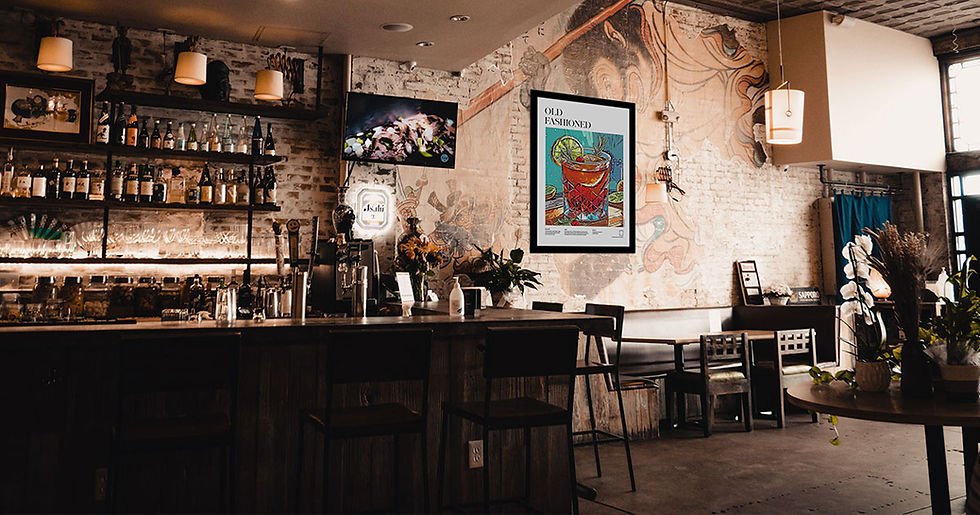
The Drink That Never Needed Reinventing: Old Fashioned Cocktail Poster
Most things that call themselves classics are coasting. A classic car is usually just an old car someone spent too much money restoring. A classic film is often just a film your parents liked that you're now obliged to pretend was ahead of its time. The word gets thrown around so freely it's almost lost all meaning — a lazy shorthand for anything that's survived long enough to accumulate nostalgia.
The Old Fashioned is the exception. It doesn't survive on nostalgia. It survives because nothing has come along in two hundred years that actually improves on it. Whiskey, sugar, bitters, a twist of citrus. That's the whole thing. No elaborate technique, no obscure liqueur sourced from a Slovenian monastery, no dry ice. Just a recipe so well-balanced that bartenders have spent two centuries trying to make it more interesting and repeatedly discovering that it isn't possible.
There's a lesson in that — about restraint, about the difference between simplicity and laziness, about how the best things tend to resist ornamentation. It's a lesson that applies equally to interior design, to illustration, to the kind of objects you choose to live with. Which is why an old fashioned cocktail poster, done properly, doesn't just look good on a wall. It says something about the person who put it there.
This is the story of that drink, and why it's earned its place in both glass and frame.
Where It Actually Came From (And Why That Matters)
The origin of the Old Fashioned is genuinely contested, which makes it more interesting, not less. The most commonly repeated story traces it to the Pendennis Club in Louisville, Kentucky, sometime in the 1880s, where a bartender supposedly created it in honour of bourbon distiller Colonel James E. Pepper. Pepper then allegedly took the recipe to the Waldorf-Astoria in New York, and from there it spread.
The problem with this story is that the cocktail almost certainly predates it. The word cocktail itself was defined in print as early as 1806 — in The Balance and Columbian Repository, a Hudson, New York newspaper — as a stimulating liquor composed of spirits of any kind, sugar, water and bitters. That's an Old Fashioned. The name is the definition. The drink is the definition. Which means the Old Fashioned isn't a cocktail inspired by classic cocktails — it is the original cocktail, the thing all the others evolved from.
By the late 19th century, as bartenders started experimenting with new ingredients — liqueurs, vermouth, exotic additions — a certain type of drinker began asking for their cocktail the old fashioned way. Just the spirit, the sugar, the bitters. The name that stuck was descriptive rather than invented, which is usually how the best names work. It describes exactly what it is: a commitment to the original form before the world decided to complicate things.
There's something philosophically tidy about that. The Old Fashioned didn't earn its name by being innovative. It earned it by refusing to be. In a culture that fetishises novelty, a drink that defines itself by resistance to novelty is, paradoxically, a statement. That tension — between timelessness and stubbornness, between confidence and conservatism — is part of what makes it such a compelling subject for design.
The Prohibition Effect and the Long Road Back
No history of American cocktails survives without acknowledging Prohibition, and the Old Fashioned is no exception. Between 1920 and 1933, legal alcohol disappeared from the United States, and with it went much of the craft that had built up around cocktail culture. What remained was survival drinking — bathtub gin, low-quality bootleg spirits, drinks that needed so much sweetener and mixer that you couldn't taste what was actually in them.
The Old Fashioned, in its proper form, requires quality whiskey. There's nowhere to hide. You can't drown bad bourbon in fruit juice. So during Prohibition and in the decades immediately following it, the drink that emerged on the other side had been compromised. Bartenders, many of them trained in a depleted tradition, started loading it up — muddled cherries, slices of orange, a cocktail cherry dropped in for good measure. The sugar got heavier. The whiskey became almost beside the point. For several decades in the mid-twentieth century, the Old Fashioned was technically still on menus but spiritually no longer itself.
The revival came in waves. The cocktail renaissance of the late 1990s and 2000s — driven partly by a renewed interest in provenance, craft spirits and pre-Prohibition recipes — brought serious bartenders back to the original construction. Then in 2007, Mad Men arrived. Don Draper, ordering Old Fashioneds with the ease of a man who considered it the only acceptable option, didn't introduce people to the drink so much as remind them it existed and make it look extraordinary. The cultural effect was immediate and measurable. Sales of rye whiskey and bourbon climbed. Old Fashioneds appeared on cocktail menus that had never previously stocked quality bitters.
It's worth noting that Draper himself is a construction — a man who built an identity from scratch and chose every element of it deliberately. His drink of choice wasn't accidental. The Old Fashioned was a character choice, a shorthand for a certain kind of self-possessed, undemonstrative confidence. The writers knew exactly what they were doing. And they were right.
What the Old Fashioned Actually Tastes Like (If You're Making It Properly)
Let's be precise, because precision matters here. A well-made Old Fashioned tastes, first and foremost, of its whiskey. That's the point. Everything else — the sugar, the bitters, the expressed orange peel — is there to frame the spirit, not to compete with it. The sugar softens the alcohol heat without sweetening the drink in any obvious way. The bitters add complexity, a slight herbal bitterness that makes the whole thing feel complete rather than one-dimensional. The citrus oil from the peel sits on the surface, giving you a different experience in the nose than in the mouth.
It should be cold, diluted just enough from the stirring, and served over a large, ideally single, block of ice. Large ice melts slowly, which means your drink doesn't become a watery apology of itself ten minutes after it arrives. These details matter. The difference between an Old Fashioned made with care and one made badly is larger than the difference between almost any other cocktail and its inferior version, precisely because there's nothing to hide behind.
The choice between bourbon and rye is a genuine preference question, not a gatekeeping exercise. Bourbon brings sweetness, vanilla, a rounder weight. Rye brings spice, dryness, a sharper edge. Both are correct. Both produce a different drink. A bartender who tells you one is definitively right is a bartender who hasn't thought hard enough about it. The best argument for rye is that it gives the bitters more to work against. The best argument for bourbon is that it's more forgiving and more immediately satisfying. Pick one. Try the other next time.
What the Old Fashioned doesn't taste like — or shouldn't — is fruit salad. The muddled cherry and orange slice tradition that crept in during the mid-century is a historical artefact of compromised ingredients and lost craft. It's not wrong in the sense of being offensive, but it is wrong in the sense of being a different drink. If you order an Old Fashioned and receive a glass of muddled fruit with whiskey poured over it, you are entitled to mild disappointment and nothing more. Life is short.
Why Cocktail Culture Became Interior Culture
At some point in the last fifteen years, the serious home bar stopped being a niche hobby and became something closer to a design statement. The growth of the craft spirits market, the influence of cocktail culture on food media, the general shift towards considered entertaining at home — all of it contributed to a world where people started thinking about their bar trolley with the same attention they gave their bookshelves or their lighting.
This isn't superficial. The objects we choose to display at home communicate something about our values and our tastes. A well-curated bar — a bottle of genuinely good bourbon, a set of proper mixing glasses, a bar spoon with actual weight to it — is a form of self-expression in the same way a carefully selected record collection or a shelf of design monographs is. It says: I take this seriously. I've made choices here. These aren't arbitrary.
Poster art fits naturally into that world, because good illustration does the same thing. An old fashioned cocktail poster isn't decoration in the way a generic print from a discount homeware shop is decoration. It's a reference. It signals a specific interest, a specific aesthetic sensibility, a specific relationship to the culture of the drink. Put it in a kitchen where someone actually uses the cocktail shaker. Put it in a home bar where the bottles behind it are chosen rather than inherited. Put it next to a drinks cabinet in a living room where people actually gather. In each case, it anchors the space to a particular idea.
There's also a purely compositional argument. The Old Fashioned, as a subject for illustration, is almost unfairly good. A lowball glass. A large cube of ice. The deep amber of the whiskey. The curl of orange peel. The visual language is already there — warm, precise, quietly confident. A good illustrator doesn't have to invent the aesthetic, they just have to render it well. The subject does half the work.
The Old Fashioned Cocktail Poster as a Design Object
When we talk about an old fashioned cocktail poster at PSB, we're not talking about the kind of thing you'd find laminated in a chain pub. We're talking about original illustration — work with a specific point of view, a considered palette, a composition that holds up at the scale it's going to live at on your wall.
The visual challenge with cocktail illustration is avoiding two failure modes. The first is technical accuracy at the expense of character — a poster that looks like a product photograph rendered in a different medium, technically correct but emotionally empty. The second is stylisation at the expense of recognition — an abstraction so aggressive you've lost the thing that made the subject interesting in the first place. The best cocktail illustration sits in the tension between those two failure modes. It's recognisably the drink. But it's also clearly a perspective on the drink.
With the Old Fashioned specifically, the colour story is everything. Warm ambers and deep golds. The darkness of a good lowball glass. The brightness of citrus against it. These are colours that work in a home environment — they're not cold, not clinical, not the kind of thing that looks like it belongs in an office. They have warmth without being saccharine. They're sophisticated without being austere. In a bar space, a kitchen, or a living room with decent lighting, they earn their place.
We'd also argue — and this is a genuine design position, not a sales pitch — that the Old Fashioned works better as a poster subject than drinks with more visual complexity. A Negroni is beautiful, but the trifecta composition of that drink is almost too obvious. A Dry Martini is elegant but notoriously difficult to make visually interesting. The Old Fashioned has just enough going on — the glass, the ice, the garnish, the colour of the spirit — to give an illustrator something to work with without becoming cluttered. It rewards restraint. Which is, of course, the whole point of the drink.
What Lasts and Why
The Old Fashioned is two hundred years old and still the drink serious bartenders cite as a benchmark. Not because they're sentimental about it. Because it works. Because the proportions are correct, the logic is sound, and no amount of subsequent innovation has improved on the underlying equation. That's not a small thing. That's actually extraordinary. Most things that are two hundred years old are in a museum. The Old Fashioned is still on the menu.
There's a broader argument here about the relationship between longevity and quality, and why it matters for the things we choose to live with. We're surrounded by objects designed for obsolescence — things built to be replaced, trends manufactured to expire, aesthetics deliberately tied to a specific cultural moment so that in five years they'll feel dated and you'll be back in the shop. The Old Fashioned is the opposite of that logic. It's a refusal of that logic.
An old fashioned cocktail poster, in this context, is more than decoration. It's an alignment with a particular set of values — craft over novelty, restraint over spectacle, things that hold up over things that merely arrive with fanfare. That sounds like it's doing a lot of philosophical work for a piece of wall art, but the best objects do carry meaning. The ones that last are usually the ones that were made with a genuine point of view and designed to endure.
Which is, in the end, why it earns wall space. Not just because it looks good — though it does. But because the drink it depicts has proven something across two centuries that most things never get the chance to prove. That getting it right the first time is enough.
Browse the Collection
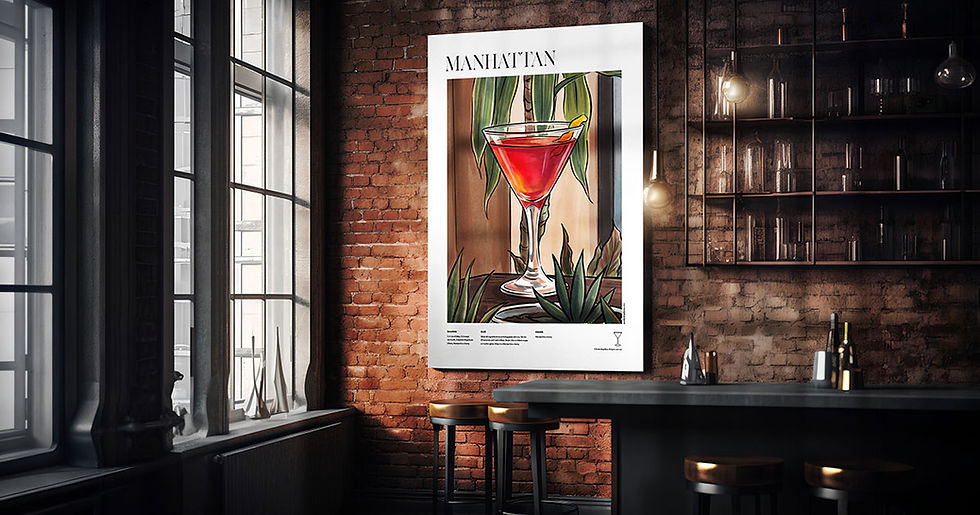
If you're looking for an old fashioned cocktail poster that actually has something to say, you'll find our full illustrated cocktail range — from Old Fashioned to Negroni, Dry Martini to Manhattan — on the site.

Comments