
What Your Kitchen Wall Art Food Poster Says About You
- Poster Shop Boys
- Jul 6
- 5 min read
Updated: 3 days ago
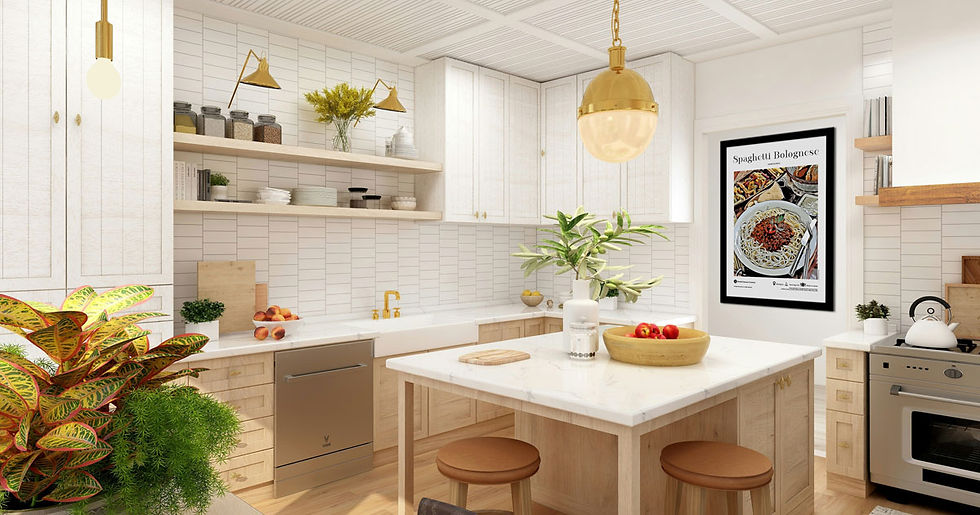
The kitchen is the only room in the house where people make genuine decisions under pressure. It's where you negotiate a Tuesday dinner with whatever's left in the fridge, where you burn the garlic and start again, where someone always ends up perched on the counter talking while you cook. It is, despite the best efforts of interior design influencers everywhere, not a showroom. It's a working space. Which makes what you choose to put on its walls more revealing than almost anywhere else.
Most people think about kitchen wall art as an afterthought — something to fill the gap between the extractor fan and the top cupboard. But the choices you make in that space, consciously or not, say quite a lot about your relationship with food, with cooking, and with what you think a kitchen is actually for.
The Herb Print Problem (And What It Actually Signals)
Let's start with the dominant aesthetic, because it deserves scrutiny. You know the one. Botanical prints of thyme, rosemary and sage, usually in muted sage green on cream, framed in thin natural wood. They're everywhere. They've been everywhere for about fifteen years. They communicate a very specific thing: I have good taste, I cook with fresh herbs, I am calm and considered in this space.
None of that is necessarily untrue. But the herb print has become so ubiquitous that it no longer communicates anything individual. It's the kitchen equivalent of saying your personality is 'a mix of introvert and extrovert.' Technically accurate. Completely devoid of information. What started as a genuine aesthetic choice has calcified into a default — something you pick because it seems right rather than because it means something.
This isn't an attack on botanical illustration, which has a legitimate and beautiful history. It's an observation about what happens when a visual language gets repeated so many times it stops speaking. The herb print used to signal someone who cared about their kitchen. Now it signals someone who went to Anthropologie and picked the least offensive option.
What It Means to Hang a Kitchen Wall Art Food Poster
Here's the thing that most kitchen wall art gets wrong: it references food abstractly rather than specifically. The result is decoration that gestures at cooking without committing to it. Vague produce. Decorative vegetables. Fruit that wouldn't look out of place in a 17th century Dutch still life but has nothing to say about the way anyone actually eats in 2025.
Choosing a kitchen wall art food poster that's about a specific dish — a real dish with a history and a culture and a reason to exist — is a fundamentally different act. It's a statement of enthusiasm rather than aesthetic compliance. A ramen poster on your kitchen wall doesn't say 'I have decorated this space.' It says 'I have eaten ramen and thought about it seriously enough to want it near me while I cook.' That's a meaningful distinction.
The best kitchen wall art food poster choices work because they carry cultural weight. Ramen is not just a bowl of noodles — it's a dish with extraordinary regional variation across Japan, a devoted craft culture built around broth and technique, and a following that borders on the devotional. A well-designed illustration of a ramen bowl earns its place on a kitchen wall the same way a film poster earns its place in a living room: because it represents something the owner genuinely cares about, rendered in a way that rewards looking at.
The same is true of paella, of sushi, of pizza — dishes that have histories and arguments and passionate adherents. Food that people fight about, in the best possible way. That energy is worth having in a kitchen.
The Unexpected Logic of Putting Something Beautiful in a Functional Room
There's a persistent idea that kitchens should be practical above all else — that investing in the aesthetic of a working space is somehow indulgent or misaligned with priorities. This is wrong, and it's worth understanding why.
Kitchens are where most people spend more waking time than any other room. Not just cooking, but the associated rituals: making coffee, eating breakfast, standing near the kettle waiting for something to happen. The ambient visual environment of that space has a measurable effect on how you feel in it. This isn't interior design mysticism — it's the same logic that makes people care about the view from a desk, or the light in an office. What you see repeatedly, at eye level, in your peripheral vision, shapes your mood in the room.
A kitchen that contains something genuinely beautiful — not 'nice', not 'tasteful', but actually arresting — functions differently to one that doesn't. The surprising observation here is this: the best argument for good kitchen wall art isn't aesthetic. It's psychological. You cook differently in a space you've invested in. You're more likely to take the extra ten minutes, to cook properly rather than just functionally, when the room itself suggests that cooking is worth taking seriously.
The Difference Between Decorating a Kitchen and Owning One
There's a version of a kitchen that belongs to no one in particular. It has everything in its right place, nothing out of character, no evidence of any specific human having lived in it enthusiastically. Show homes have kitchens like this. Certain rental properties have kitchens like this. They are perfectly acceptable and entirely forgettable.
And then there are kitchens that clearly belong to someone. Where the choices accumulate into something coherent and individual — not because they were planned that way, but because they reflect a genuine point of view. The right kitchen wall art food poster is partly a design decision and partly a territorial one. It's a way of saying: this space has been claimed by someone who cooks with intention and lives with taste.
This is why the choice of what to hang matters more than whether to hang anything at all. A thoughtfully chosen kitchen wall art food poster — something with a strong illustrative hand, a dish with genuine cultural depth, a design that holds up to daily proximity — does more to make a kitchen feel inhabited than any number of carefully coordinated accessories. It introduces something irreducibly personal into a room that often gets treated as purely functional.
Why a Kitchen Wall Art Food Poster Works Harder Than Photography
Photographic food prints present an obvious problem in a kitchen: they compete with reality. A photographic image of a perfectly plated dish, hung above an actual kitchen counter, creates a comparison that neither the image nor the room can comfortably win. The image looks clinical. The counter looks messy. Everyone is vaguely dissatisfied.
A kitchen wall art food poster that's illustrated sidesteps this entirely. A great illustration of a bowl of ramen or a wood-fired pizza isn't trying to document reality — it's interpreting it. It makes a creative argument about what the dish looks like at its most essential, its most characterful. The result sits comfortably alongside the actual business of cooking because it's not in competition with it. It occupies a different register. It belongs on a wall in a way that a photograph sometimes doesn't.
There's also the question of longevity. Photographic food imagery dates. Illustration, done well, doesn't — or at least it ages far more gracefully. The visual language of good illustrative work has a permanence that trend-led photography struggles to match. You're not going to wake up in five years and feel embarrassed by a well-executed line drawing of a sushi platter. You might well feel differently about a moody overhead shot of a charcuterie board.
Browse the Collection
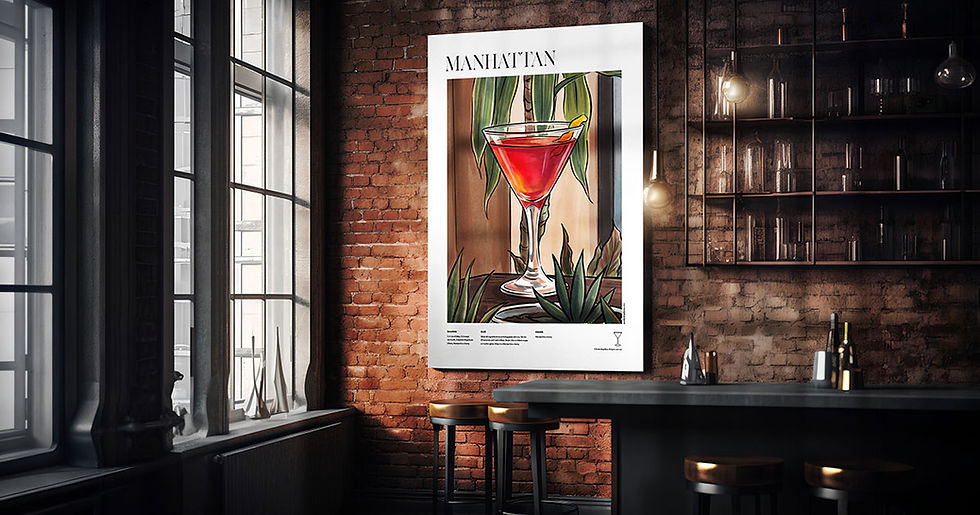
If any of this has made you look at your kitchen wall and find it wanting, that's probably the right response. We've designed a range of food posters — ramen, sushi, paella, pizza — built around dishes that deserve to be taken seriously, illustrated in a way that holds up in a room you actually use.


Comments